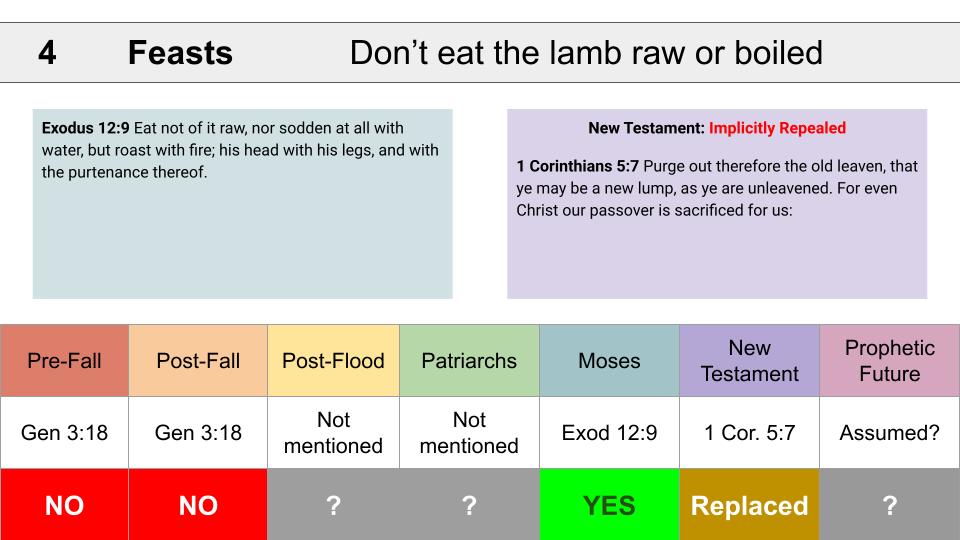
Much of this fourth commandment was covered in the discussion of the 3rd Mosaic Commandment. However we’ll look at the methodology of this commandment:
Not Raw
Not sodden with water (boiled)
As we’ll see in Numbers 20 – method is important. Because Moses struck the rock instead of speaking to it, he destroyed God’s symbolism and was banned from the Promised Land.
[8] Take the rod, and gather thou the assembly together, thou, and Aaron thy brother, and speak ye unto the rock before their eyes; and it shall give forth his water, and thou shalt bring forth to them water out of the rock: so thou shalt give the congregation and their beasts drink. [9] And Moses took the rod from before the LORD, as he commanded him. [10] And Moses and Aaron gathered the congregation together before the rock, and he said unto them, Hear now, ye rebels; must we fetch you water out of this rock? [11] And Moses lifted up his hand, and with his rod he smote the rock twice: and the water came out abundantly, and the congregation drank, and their beasts also. [12] And the LORD spake unto Moses and Aaron, Because ye believed me not, to sanctify me in the eyes of the children of Israel, therefore ye shall not bring this congregation into the land which I have given them.
So as we’ve seen earlier – the instructions are inapplicable in early human history, unknown between the Flood and Moses, and replaced by a new Passover Lamb in the New Testament:
Purge out therefore the old leaven, that ye may be a new lump, as ye are unleavened. For even Christ our passover is sacrificed for us:
1 Corinthians 5:7
Interestingly the requirement for it to be cooked not raw or boiled is not reiterated in the Ezekiel declaration so we might assume that it is assumed as it is not addressed.
Commentaries address this part of the symbolism:
Justin Martyr says that it was prepared for roasting by means of two wooden spits, one perpendicular and the other transverse, which extended it on a sort of cross, and made it aptly typify the Crucified One.
It was to be slain, and roasted with fire, denoting the painful sufferings of the Lord Jesus, even unto death, the death of the cross. The wrath of God is as fire, and Christ was made a curse for us.
In our continuing look at the Passover laws of Moses in the Mosaic Code – you’ll notice that we have a handy dandy chart comparing this command across the times of God’s dealings with man. The academic term is dispensations – but we try to simplify it from a book that does not have enough pictures in it, into a tool to study the Bible chronologically. The more you study Genesis – the more you realize that it’s a big book – it covers roughly 3,500 years of human history, and 4 different time periods of God’s dealings with man. Which brings us to the Passover dinner…
or attend an actual one, (I’m not qualified to explain the Seder – I’ll leave that for our Jewish friends) let’s look at the Biblical requirements for a Passover seder:
And they shall eat the flesh in that night, roast with fire, and unleavened bread; and with bitter herbs they shall eat it.
Exodus 12:8
In case you missed it in Exodus and want a post-Sinai command:
The fourteenth day of the second month at even they shall keep it, and eat it with unleavened bread and bitter herbs.
Numbers 9:11
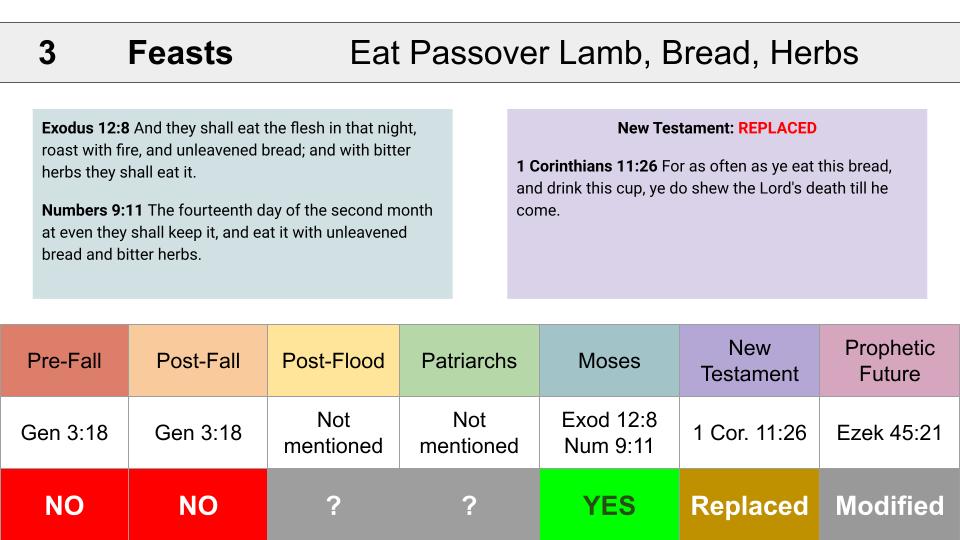
Notice the three elements – the Lamb, the Unleavened Bread, and the Bitter Herbs.
The Bitter Herbs
While there have been sacrifices going back to just after the Garden of Eden as we saw in Commandment 2, there is something distinctly different about Passover versus the early sacrifices: Meat!
Thorns also and thistles shall it bring forth to thee; and thou shalt eat the herb of the field;
Genesis 3:18
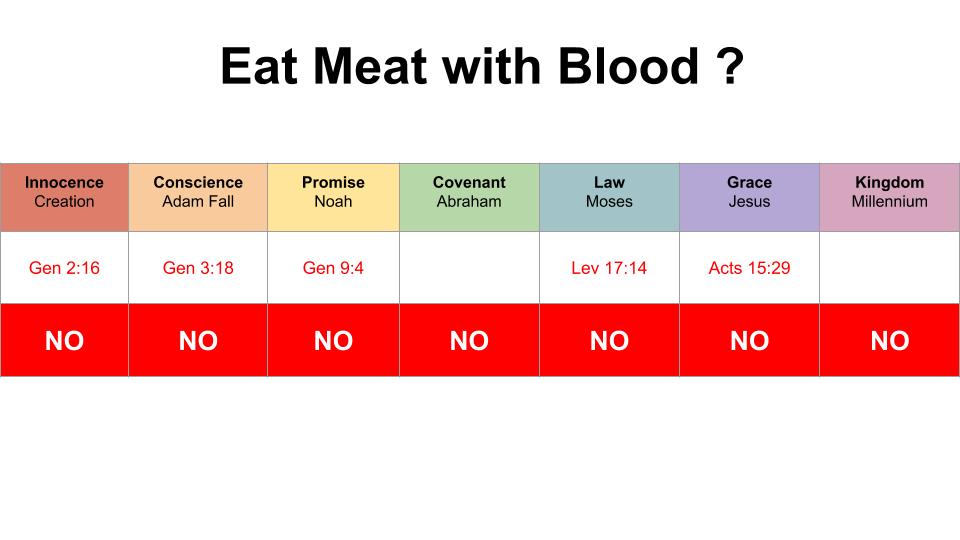
That’s right – from the Garden of Eden until the Flood – no meat was allowed to be consumed! So the first two dispensations could offer sacrifices but not partake of the meat of the sacrifice.
Every moving thing that liveth shall be meat for you; even as the green herb have I given you all things.
Genesis 9:3
So now that we are post-flood the meat of the sacrifice could be eaten – and yet we don’t read of any of the Patriarchs partaking of the meat of the offering. We do see a curious reference to bread with a sacrifice:
Then Jacob offered sacrifice upon the mount, and called his brethren to eat bread: and they did eat bread, and tarried all night in the mount.
Genesis 31:54
Now when we have the New Testament we see Jesus modifying the procedure for observance of Passover – let’s look at what Paul says that was so important that it was specifically revealed to the apostle born out of due season:
[23] For I have received of the Lord that which also I delivered unto you, That the Lord Jesus the same night in which he was betrayed took bread: [24] And when he had given thanks, he brake it, and said, Take, eat: this is my body, which is broken for you: this do in remembrance of me. [25] After the same manner also he took the cup, when he had supped, saying, This cup is the new testament in my blood: this do ye, as oft as ye drink it, in remembrance of me. [26] For as often as ye eat this bread, and drink this cup, ye do shew the Lord’s death till he come. [27] Wherefore whosoever shall eat this bread, and drink this cup of the Lord, unworthily, shall be guilty of the body and blood of the Lord. [28] But let a man examine himself, and so let him eat of that bread, and drink of that cup.
1 Corinthians 11:23-28
Notice something missing? The bitter herbs (Hebrew: Maror)!
Interestingly enough Jewish scholars claim:
the biblical notion of eating maror to remember our slavery no longer applies
In the New Testament we see the Lord’s Supper replacing Passover as a required observance for the Christian. And yet as we saw – this isn’t the end of Passover. In the Millennial Kingdom it will return – but without the bitter herbs!
In the first month, in the fourteenth day of the month, ye shall have the passover, a feast of seven days; unleavened bread shall be eaten.
Ezekiel 45:21
So we see across the dealings of God with man:
Innocence – no sacrifice needed, for no sin; and because of no sin, no death
Conscience – sacrifice needed, but man not able to partake of the sacrifice
Government – sacrifice needed, man now allowed to eat meat but not specified if partook of sacrifice
Promise – sacrifice needed, interestingly one sacrifice is associated with eating of bread
Law – sacrifice needed, associated with bread and bitter herbs
Grace – sacrifice was finished, commemorated with bread and grape juice (blood of the lamb)
Kingdom – sacrifice reinstated, associated with bread but not bitter herbs.
So – is there significance to the fact that after The Messianic Passover Lamb was sacrificed, the bitter herbs were removed from the ordinance?
As is thrown out on Wikipedia,
The word derives from the Hebrew word mar (מֵר or מָרָה, “bitter”), and so may be related to the English word myrrh (through Aramaic ܡܪܝܪܐ mriro, cognate with Arabic مرّ murr).
Is there a connection between the Hebrew “bitter herbs” and the myrrh of the wise men?
Myrrh was also a product of Arabia, and was obtained from a tree in the same manner as frankincense. It was a spice and was used in embalming. It was also sometimes mingled with wine to form an article of drink. Such a drink was given to our Savior when He was about to be crucified, as a stupefying potion (Mark 15:23). Matthew 27:34 refers to it as “gall.” Myrrh symbolizes bitterness, suffering, and affliction. The baby Jesus would grow to suffer greatly as a man and would pay the ultimate price when He gave His life on the cross for all who would believe in Him.
Was the “bitter herbs” as myrrh a prediction of his burial?
Nicodemus came, Nicodemus who didn’t believe on that occasion, and who was warned that he would be condemned if he didn’t believe. That was one of the harshest conversations Jesus ever had with a spiritual leader. He has now made up his mind and also become a follower of Jesus. He had first come to Him by night. He brings “a mixture of myrrh and aloes, a hundred pound weight.” Best calculation that I can do is about 65 pounds; that would be fit for a king, for this man’s got some means as well. He shows up….
Myrrh is a fragrant, gummy resin that’s made in a powdered form – very, very strong fragrance. And aloes you’re more familiar with. It comes from the leaves of the sandalwood tree and also is an aromatic powder. And they mix all of that so that they would literally overpower the stench with other fragrance, and they would just dump it in great quantities in between the strips as they wrap the body and then put a cloth over them.
Mosaic Law #2 – Feasts – Kill Passover Lamb on Abib 14
So you may wonder by now how they came up with the number 613 for the laws of Moses. The short answer is Rabbi Maimonides. However the exact number is debatable. We’ll use Maimonides list however we’ll start with Moses (excluding Genesis 1:28 and Genesis 32:33) because we want to focus on what is academically referred to as the dispensation of law. (What allows me to modify the great Maimonides’ list of commands? Chutzpah!) Now a cursory scan of the New Testament will reveal that while there is not statutory law (if you are found guilty of crime X, you must pay restitution of Z) as is found frequently in the Pentateuch, rather you will find significantly more imperatives. According to one count there are over 1,000 commands in the New Testament (49 by Jesus alone).
The Passover commands precede the giving of the Ten Commandments in Exodus 20 but we can connect the Passover law of Exodus 12 to the later legal code and thus concur with Maimonides.
As we saw in Commandment 1 (not in priority order) the first step is to re-order the calendar from Creation-centric to Passover-centric. Here we see the Passover is tied to the first full moon of the re-ordered year – as the lunar month starts at the New Moon.
And ye shall keep it up until the fourteenth day of the same month: and the whole assembly of the congregation of Israel shall kill it in the evening.
Exodus 12:6
And to find the latter discussion in the Torah
And in the fourteenth day of the first month is the passover of the LORD.
Numbers 28:16
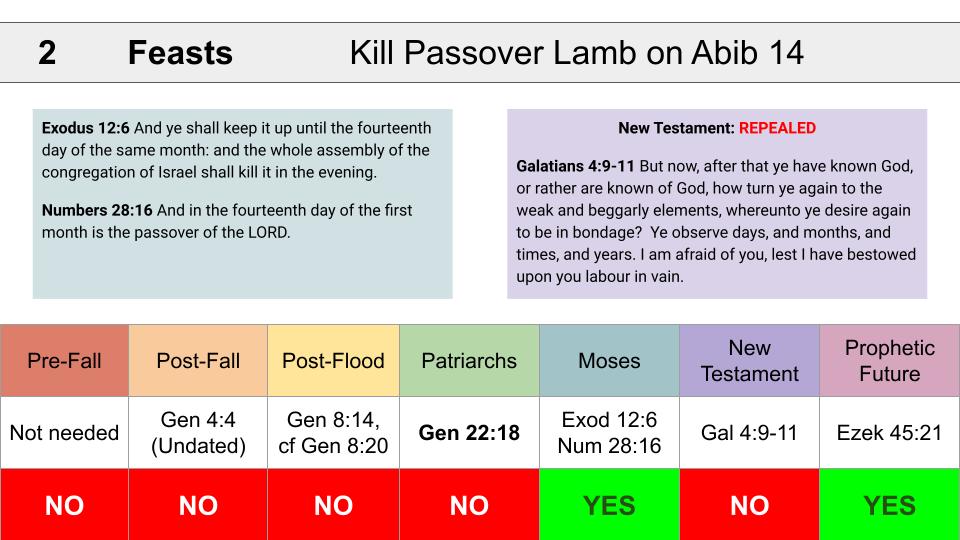
Again, dispensationalism explains that while there were significant sacrifices post-fall (i.e. none in the first dispensation of Innocence), there was not a set date until Moses.
And Abel, he also brought of the firstlings of his flock and of the fat thereof. And the LORD had respect unto Abel and to his offering:
Genesis 4:4
In fact, the Noahic post-flood sacrifice was at the end of the second month of the Creation Calendar
[13] And it came to pass in the six hundredth and first year, in the first month, the first day of the month, the waters were dried up from off the earth: and Noah removed the covering of the ark, and looked, and, behold, the face of the ground was dry. [14] And in the second month, on the seven and twentieth day of the month, was the earth dried. [20] And Noah builded an altar unto the LORD; and took of every clean beast, and of every clean fowl, and offered burnt offerings on the altar.
Genesis 8:13-14, 20
The most significant individual sacrifice was that of Abraham offering the ram instead of Isaac.
[13] And Abraham lifted up his eyes, and looked, and behold behind him a ram caught in a thicket by his horns: and Abraham went and took the ram, and offered him up for a burnt offering in the stead of his son.
Genesis 22:13
Compare this to the Passover – a sacrifice offered in place of the firstborn son.
[12] For I will pass through the land of Egypt this night, and will smite all the firstborn in the land of Egypt, both man and beast; and against all the gods of Egypt I will execute judgment: I am the LORD. [13] And the blood shall be to you for a token upon the houses where ye are: and when I see the blood, I will pass over you, and the plague shall not be upon you to destroy you, when I smite the land of Egypt.
Exodus 12:12-13
But now in the New Testament, Paul – the Jew par excellence –
And profited in the Jews’ religion above many my equals in mine own nation, being more exceedingly zealous of the traditions of my fathers.
Galatians 1:14
says this command is null to focus on a date
But now, after that ye have known God, or rather are known of God, how turn ye again to the weak and beggarly elements, whereunto ye desire again to be in bondage?
Ye observe days, and months, and times, and years.
I am afraid of you, lest I have bestowed upon you labour in vain.
Galatians 4:9-11
Why was this command revoked? It was fulfilled! Instead of a regular annual sacrifice, The Sacrifice was made once for us, as Hebrews 9 focuses on.
[12] Neither by the blood of goats and calves, but by his own blood he entered in once into the holy place, having obtained eternal redemption for us.
[25] Nor yet that he should offer himself often, as the high priest entereth into the holy place every year with blood of others;
[26] For then must he often have suffered since the foundation of the world: but now once in the end of the world hath he appeared to put away sin by the sacrifice of himself.
Hebrews 9:12, 25-26
Amazingly, the date of The Passover Lamb’s sacrifice was tied to the annual Passover observance
[2] Ye know that after two days is the feast of the passover, and the Son of man is betrayed to be crucified.
Matthew 26:2
While churches may recognize Good Friday, more importantly we can recognize the date that the blood of The Substitutionary Lamb
[29] The next day John seeth Jesus coming unto him, and saith, Behold the Lamb of God, which taketh away the sin of the world.
John 1:29
was applied to our heart’s door! If you haven’t done that – Today can be the Day!
[2] (For he saith, I have heard thee in a time accepted, and in the day of salvation have I succoured thee: behold, now is the accepted time; behold, now is the day of salvation.)
2 Corinthians 6:2
But as we saw with the previous commandment, in the future Millennial Kingdom, Passover will once again be observed.
In the first month, in the fourteenth day of the month, ye shall have the passover, a feast of seven days; unleavened bread shall be eaten.
Ezekiel 45:21
Just as Moses looked forward to The Passover Lamb, so the Millennial Temple will look backward to The Passover Lamb!
We’ll be starting a look at the 613 laws of Moses from a dispensational point of view. Why a dispensational point of view? Well – if you stayed up late for New Years Eve – you might be a dispensationalist – because March 13th, 2021 (check your lunar calendars for other years) is the Mosaic New Years Eve celebration!
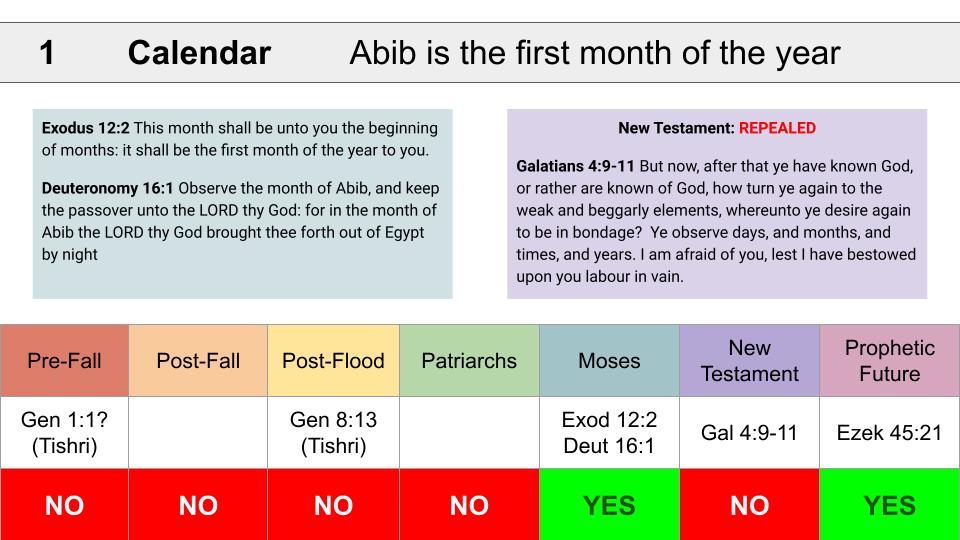
That’s right – the Mosaic law altered the calendar of Creation (according to Jewish tradition Rosh Hashanah – or Tishri 1 – is the date of the Creation of the World, and the Jewish calendar adds another number to the Anno Mundi on that date). You may also know Rosh Hashanah as the Feast of Trumpets, considered by some to be the date of the upcoming Rapture of the Church. If you want an interesting rabbit trail – consider Year 6000 – especially if you follow Ussher’s Chronology as opposed to the Anno Mundi.
So from Adam through Noah – the calendar started with Tishri
And it came to pass in the six hundredth and first year, in the first month, the first day of the month, the waters were dried up from off the earth: and Noah removed the covering of the ark, and looked, and, behold, the face of the ground was dry.
Genesis 8:13
So Moses reset the calendar that was given to Adam:
This month shall be unto you the beginning of months: it shall be the first month of the year to you.
Exodus 12:2
Observe the month of Abib, and keep the passover unto the LORD thy God: for in the month of Abib the LORD thy God brought thee forth out of Egypt by night.
Deuteronomy 16:1
but under the New Testament we were told that calendar observation isn’t worth our time!
But now, after that ye have known God, or rather are known of God, how turn ye again to the weak and beggarly elements, whereunto ye desire again to be in bondage? Ye observe days, and months, and times, and years. I am afraid of you, lest I have bestowed upon you labour in vain.
Galatians 4:9-11
Paul upends the very first Mosaic command (and quite a few others as we will see) calling it a “weak and beggarly element” and a tool of “bondage.”
But lets skip forward 2,000 years from Paul and look into the next Millennium and we see another change of the calendar!
Thus saith the Lord GOD; In the first month, in the first day of the month, thou shalt take a young bullock without blemish, and cleanse the sanctuary:
Exodus 45:18
Interesting – a new ceremony for Abib 1 – the cleansing of the sanctuary! How do we know this first month is the month Abib – the month of the Mosaic New Year? Well – the definitive feature of the Mosaic New Year is the Passover!
In the first month, in the fourteenth day of the month, ye shall have the passover, a feast of seven days; unleavened bread shall be eaten.
Exodus 45:21
So we have one calendar from Adam to Moses, another from Moses to Paul, the Church age is free from calendar mandates, but in the Millennial kingdom there will be a return of the Mosaic calendar with a New Year’s Day purification of the sanctuary!
[1] Behold, I will send my messenger, and he shall prepare the way before me: and the Lord, whom ye seek, shall suddenly come to this temple, even the messenger of the covenant, whom ye delight in: behold, he shall come, saith the LORD of hosts. [2] But who may abide the day of his coming? and who shall stand when he appeareth? for he is like a refiner’s fire, and like fullers’ soap: [3] And he shall sit as a refiner and purifer of silver: and he shall purify the sons of Levi, and purge them as gold and silver, that they may offer unto the LORD an offering in righteousness. [4] Then shall the offering of Judah and Jerusalem be pleasant unto the LORD, as in the days of old, and as in former years.
Malachi 3:1-4
[15] And they come to Jerusalem: and Jesus went into the temple, and began to cast out them that sold and bought in the temple, and overthrew the tables of the moneychangers, and the seats of them that sold doves; [16] And would not suffer that any man should carry any vessel through the temple. [17] And he taught, saying unto them, Is it not written, My house shall be called of all nations the house of prayer? but ye have made it a den of thieves.
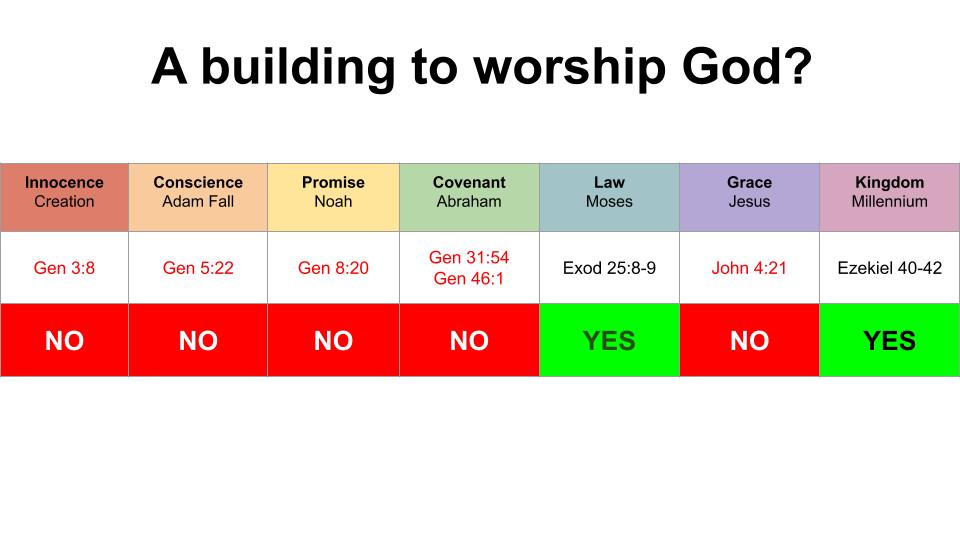
While in other dispensations the altars were found in various locales, only in the Law and in the Kingdom will there be a specific building to worship God.
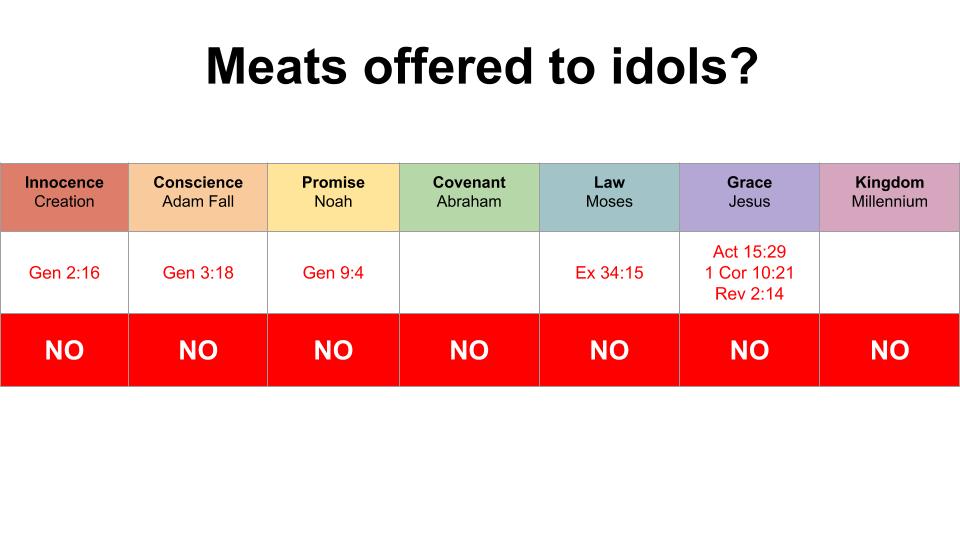
Across all dispensations, it is forbidden to eat meats offered to idols. The apostles collectively, the Apostle Paul specifically, and the Lord Jesus Himself warn against it.
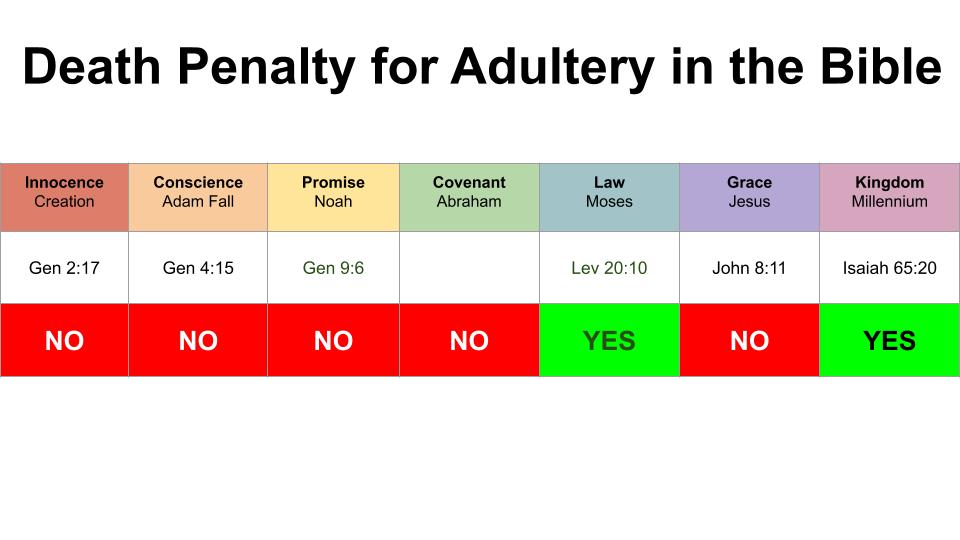
Adultery is handled differently by dispensation. No command against adultery was given in the first dispensations – only homicide was connected to capital punishment until Moses.
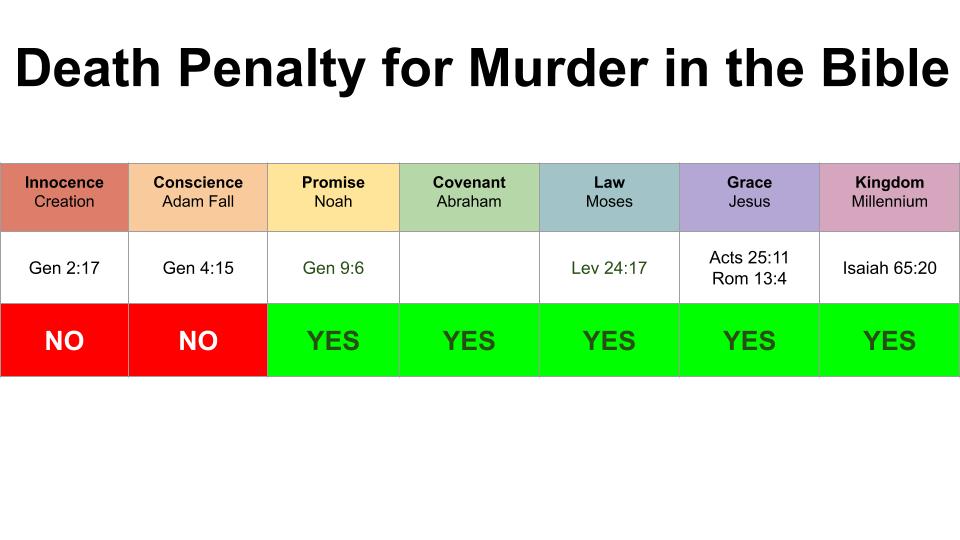
Murder is prohibited, but the penalty varies by dispensation. God did not command Cain to be killed by man – rather He protected Him. This would change.

 Dispensationalism and the Law