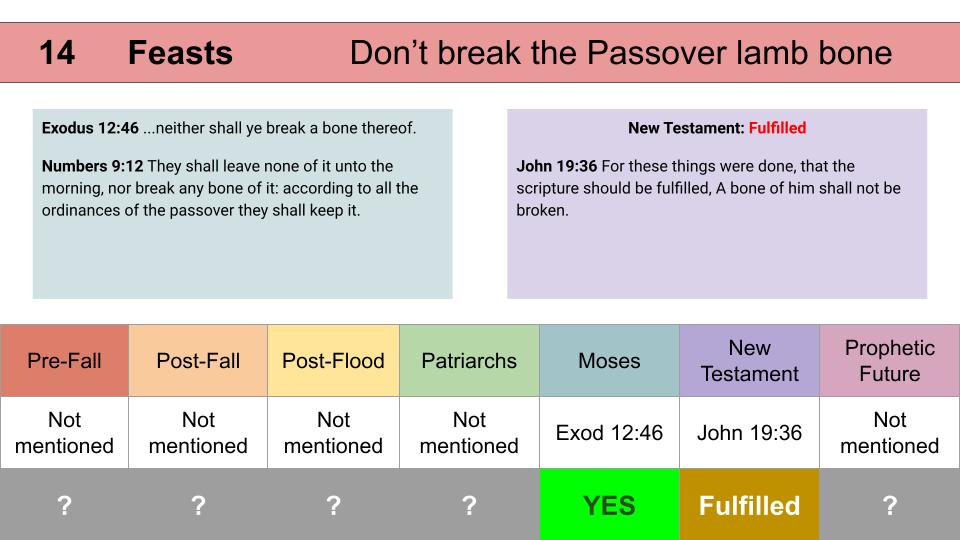
Interestingly while we read of sacrifices shortly after the fall (the source of the skins), sacrifices of Cain and Abel, sacrifices of Noah, and sacrifices of Abraham, Isaac, and Jacob, there was one factor that was not mentioned until the Mosaic code: not breaking a bone!
This command is mentioned twice in the Mosaic Code, and then in Psalms:
He keepeth all his bones: not one of them is broken.
Psalms 34:20
Then we finally see a New Testament fulfillment!
For these things were done, that the scripture should be fulfilled, A bone of him shall not be broken.
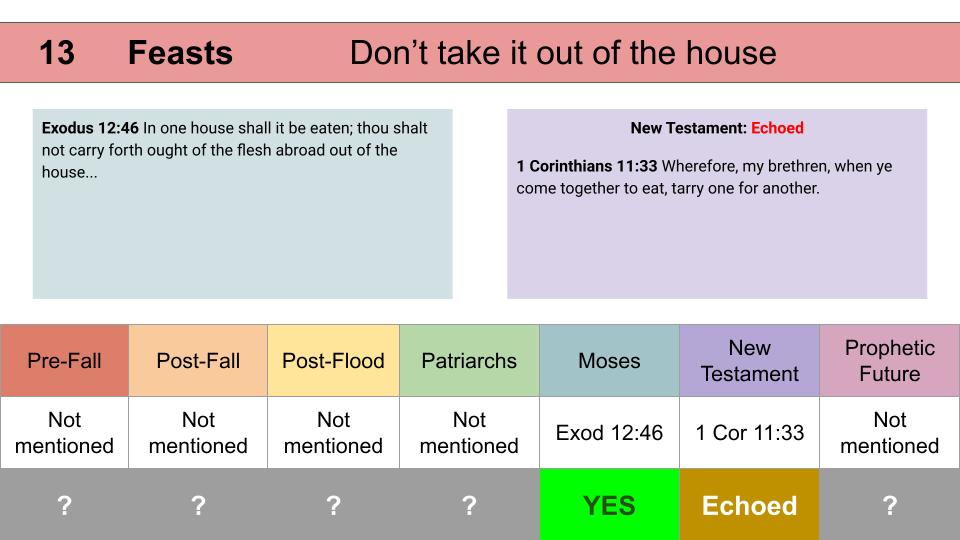
The Bible has some interesting specifics in the Mosaic Code when it comes to food and days. Passover was not meant to be “fast food” – it was required to stay in the house. This passage seems inapplicable at first glance in the New Testament – but when we read Paul’s teaching on the Lord’s Supper, we see an “echo” of the command: “Tarry one for another.”
We’ll see a few chapters ahead the origin of the Sabbath day’s journey as God appears to restrict geographic movement.
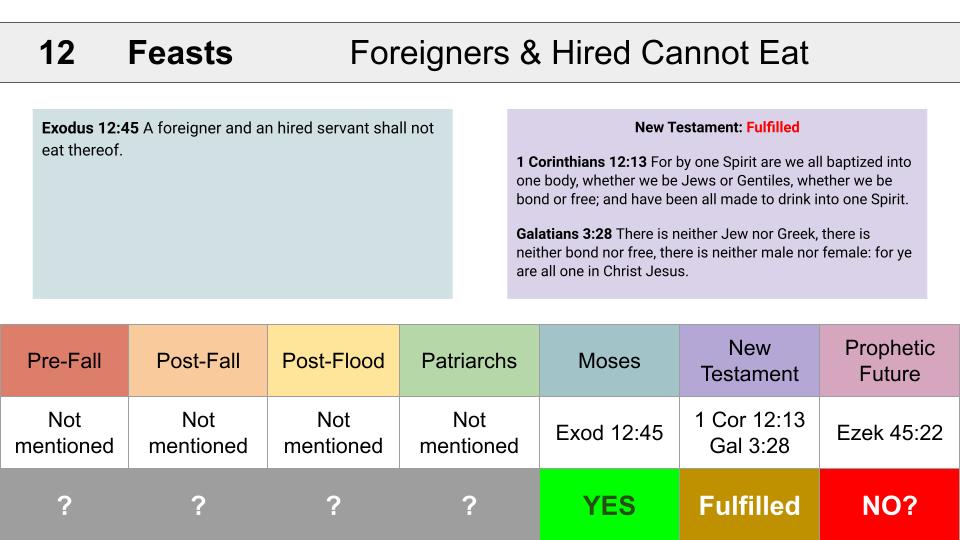
As we continue our look at the Mosaic Code’s Passover instructions – we see another nuance in the eligibility to participate. Ordinance 10 said strangers could not eat, but then Ordinance 11 gave an exception for one class that could eat (circumcised servants), and we see reiterated the two classes that may not – foreigners (merchants?) and hired servants (temporary workers).
A foreigner and an hired servant shall not eat thereof.
Exodus 12:45
What’s interesting is that in the New Testament we see the ethnic origin and bond-status categories removed when it comes to the unity in the body that celebrates the replacement ceremony of the Lord’s Supper.
For by one Spirit are we all baptized into one body, whether we be Jews or Gentiles, whether we be bond or free; and have been all made to drink into one Spirit.
There is neither Jew nor Greek, there is neither bond nor free, there is neither male nor female: for ye are all one in Christ Jesus.
1 Corinthians 12:13 and Galatians 3:28
Interestingly it seems that this is carried into the prophetic future – the universal application of the future Passover that does not discuss circumcision, but talks about “all the people.”
And upon that day shall the prince prepare for himself and for all the people of the land a bullock for a sin offering.
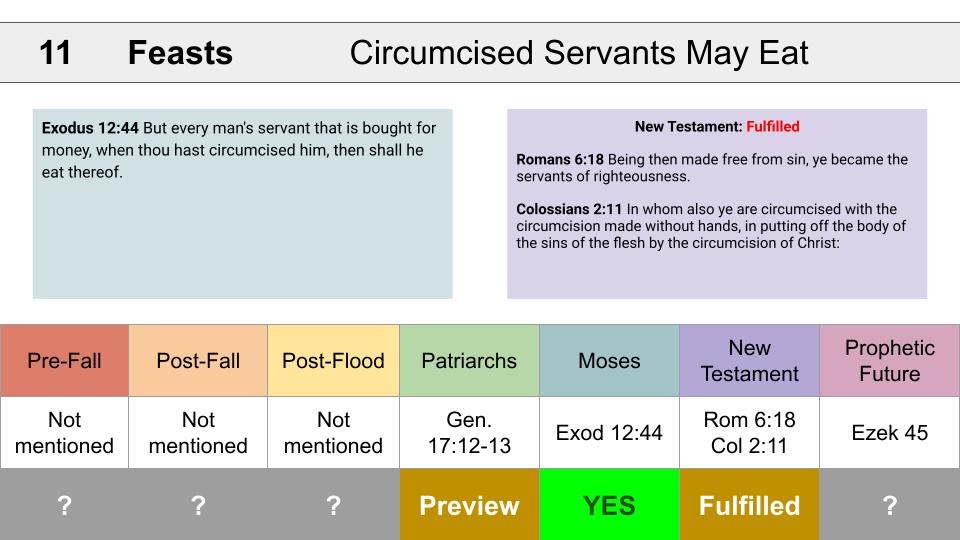
We see an interesting feature of statutory law – the commandment that no stranger may eat of the Passover, and then followed by this exception to the statute, covering a subset of the prohibited class. One type of strangers, rather than being prohibited from fellowship, must be brought into the fellowship.
But every man’s servant that is bought for money, when thou hast circumcised him, then shall he eat thereof.
Exodus 12:44
Among the types of strangers, we’ve seen the ‘free’ long term resident and the ‘free’ short term resident, the day laborer, and the long term ‘servant.’ This ‘servant’ is a euphemism for the more provocative word, slave.
The foreigner that belongs to a member of the community of God – though he is a slave, yet is he invited to the high feast.
Before Passover, we see this command in the earlier dispensation:
And he that is eight days old shall be circumcised among you, every man child in your generations, he that is born in the house, or bought with money of any stranger, which is not of thy seed.
He that is born in thy house, and he that is bought with thy money, must needs be circumcised: and my covenant shall be in your flesh for an everlasting covenant.
Genesis 17:12-13
The New Testament explains this command – we were bought – yet not with money!
Forasmuch as ye know that ye were not redeemed with corruptible things, as silver and gold, from your vain conversation received by tradition from your fathers;
1 Peter 1:8
For ye are bought with a price: therefore glorify God in your body, and in your spirit, which are God’s.
1 Corinthians 16:20
Are we in bondage? Paul spent much time in his epistle to the Galatians telling how we are free, but yet in other epistles he notes that we are still slaves:
Being then made free from sin, ye became the servants of righteousness.
Romans 6:18
But now that we are purchased and bound to the family of God – are we circumcised?
In whom also ye are circumcised with the circumcision made without hands, in putting off the body of the sins of the flesh by the circumcision of Christ:
So we will slightly depart from Maimonides’ list of the 613 laws – because Maimonides tried to apply them to a post-Temple dispensation that forked from God’s dispensation of Grace.
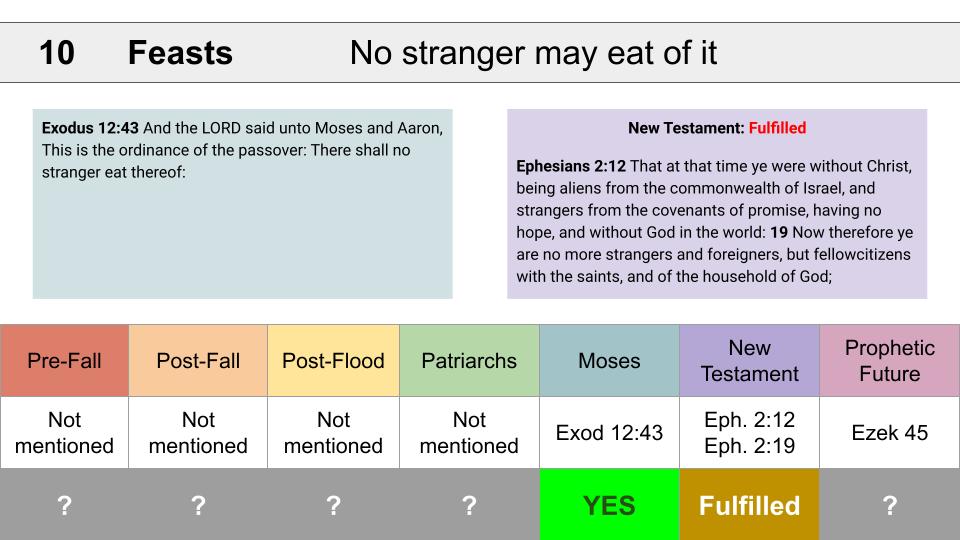
And the LORD said unto Moses and Aaron, This is the ordinance of the passover: There shall no stranger eat thereof:
Exodus 12:43
Maimonides, who was born on Passover Eve, interpreted strangers as apostates. Maimonides’ work often dealt with this issue of apostasy (from Judaism) because of forced conversions in traditional Jewish settlements.
However, taking a historical-grammatical approach to Scripture, we must look at who are the strangers of Exodus 12:43. We’re told by some sources there were short-term and long-term strangers, but there may be a different way to categorize strangers by looking at the text itself.
[44] But every man’s servant that is bought for money, when thou hast circumcised him, then shall he eat thereof. [45] A foreigner and an hired servant shall not eat thereof.
[48] And when a stranger shall sojourn with thee, and will keep the passover to the LORD, let all his males be circumcised, and then let him come near and keep it; and he shall be as one that is born in the land: for no uncircumcised person shall eat thereof.
Exodus 12
There appears to be non-Hebrews bound to Hebrews, non-Hebrews unbound, and non-Hebrews bound to non-Hebrews (either by blood – biological son, adopted son – or by otherwise). However you parse it, this is the first distinction in Mosaic code between the first two strands of the human family that Jimmy DeYoung was fond of discussing – the Gentiles and the Jews.
In the New Testament, Paul the learned Jewish sage explains what happened to the strangers. Note that Paul is discussing non-proselytes as opposed to proselytes (Gentiles that were circumcised could identify as Jews and participate in the Passover – we’ll discuss them in a future command) because circumcision was not the distinguishing mark of the third strand of the human family, Christians.
Where there is neither Greek nor Jew, circumcision nor uncircumcision, Barbarian, Scythian, bond nor free: but Christ is all, and in all.
Colossians 3:11
So what happened to these uncircumcised strangers? They had no hope!
12 That at that time ye were without Christ, being aliens from the commonwealth of Israel, and strangers from the covenants of promise, having no hope, and without God in the world:
19 Now therefore ye are no more strangers and foreigners, but fellowcitizens with the saints, and of the household of God;
Ephesians 2
God took hopeless strangers cut off from the Passover – and made them part of His household!
Those who could not participate in the symbol of the deliverance, are made partakers of the substance of deliverance!
As we continue our look at the Mosaic Code, the prohibition on leaven for the seven days of Abib is further clarified
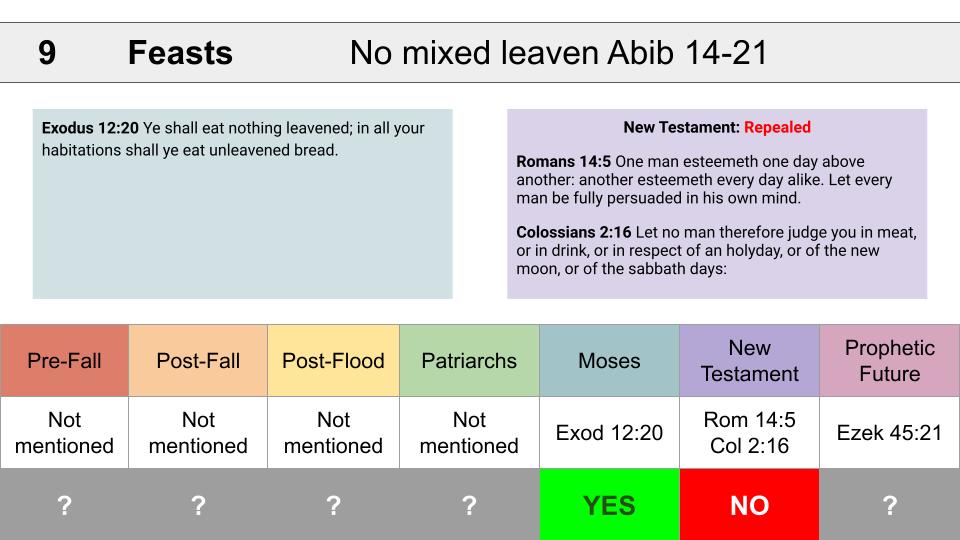
Ye shall eat nothing leavened; in all your habitations shall ye eat unleavened bread.
Exodus 12:20
Nothing leavened – no mixtures of leaven and the unleavened. We’ll see other commands about the need to avoid mixing ‘good’ and ‘bad’ – a strong visual reminder of the symbolic idea of purity.
Ye shall keep my statutes. Thou shalt not let thy cattle gender with adiverse kind: thou shalt not sow thy field with mingled seed: neither shall a garment mingled of linen and woollen come upon thee.
Leviticus 19:19
What did Jesus say?
No servant can serve two masters: for either he will hate the one, and love the other; or else he will hold to the one, and despise the other. Yecannot serve God and mammon.
Luke 16:13
Strangely enough people are trying to serve two masters today!
When the pandemic freed employees from having to report to the office, some saw an opportunity to double their salary on the sly. Why be good at one job, they thought, when they could be mediocre at two?
This law might look familiar – the 6th Mosaic command stated you had to remove the leaven, but this command continues to state you cannot bring it back for seven days.
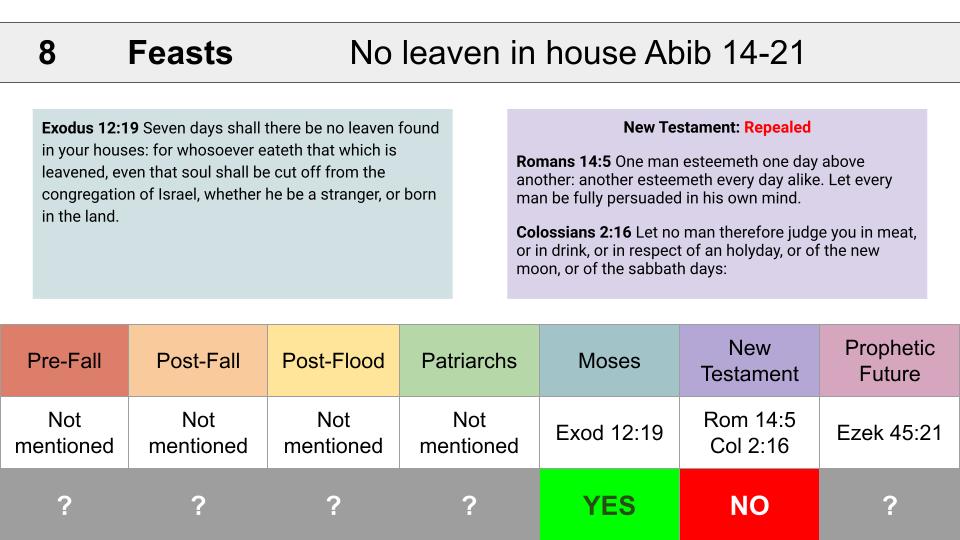
Seven days shall there be no leaven found in your houses: for whosoever eateth that which is leavened, even that soul shall be cut off from the congregation of Israel, whether he be a stranger, or born in the land.
Exodus 12:19
Most people think of the Mosaic Code as austere – but they are thinking of the Mishnah. The Torah really isn’t as massive as we think – compare the 613 laws of Moses to over 16,000 laws in Wisconsin alone (not counting federal regulations). And much the Torah focuses on ceremonial law – festivals, sacrifices, and temple-specific regulation.
So what’s the big deal about leaven? Paul uses it as an illustration of fornication:
[1] It is reported commonly that there is fornication among you, and such fornication as is not so much as named among the Gentiles, that one should have his father’s wife. [2] And ye are puffed up, and have not rather mourned, that he that hath done this deed might be taken away from among you. [3] For I verily, as absent in body, but present in spirit, have judged already, as though I were present, concerning him that hath so done this deed, [4] In the name of our Lord Jesus Christ, when ye are gathered together, and my spirit, with the power of our Lord Jesus Christ, [5] To deliver such an one unto Satan for the destruction of the flesh, that the spirit may be saved in the day of the Lord Jesus. [6] Your glorying is not good. Know ye not that a little leaven leaveneth the whole lump? [7] Purge out therefore the old leaven, that ye may be a new lump, as ye are unleavened. For even Christ our passover is sacrificed for us: [8] Therefore let us keep the feast, not with old leaven, neither with the leaven of malice and wickedness; but with the unleavened bread of sincerity and truth. [9] I wrote unto you in an epistle not to company with fornicators: [10] Yet not altogether with the fornicators of this world, or with the covetous, or extortioners, or with idolaters; for then must ye needs go out of the world. [11] But now I have written unto you not to keep company, if any man that is called a brother be a fornicator, or covetous, or an idolater, or a railer, or a drunkard, or an extortioner; with such an one no not to eat. [12] For what have I to do to judge them also that are without? do not ye judge them that are within? [13] But them that are without God judgeth. Therefore put away from among yourselves that wicked person.
1 Corinthians 5
With the same devotion that the ancient Hebrews had to following the Passover to celebrate the deliverance God had brought to them accompanied by devotion to a pure “unleavened” home, so must we seek to have our lives pure and “unleavened” by fornication or any other sin.
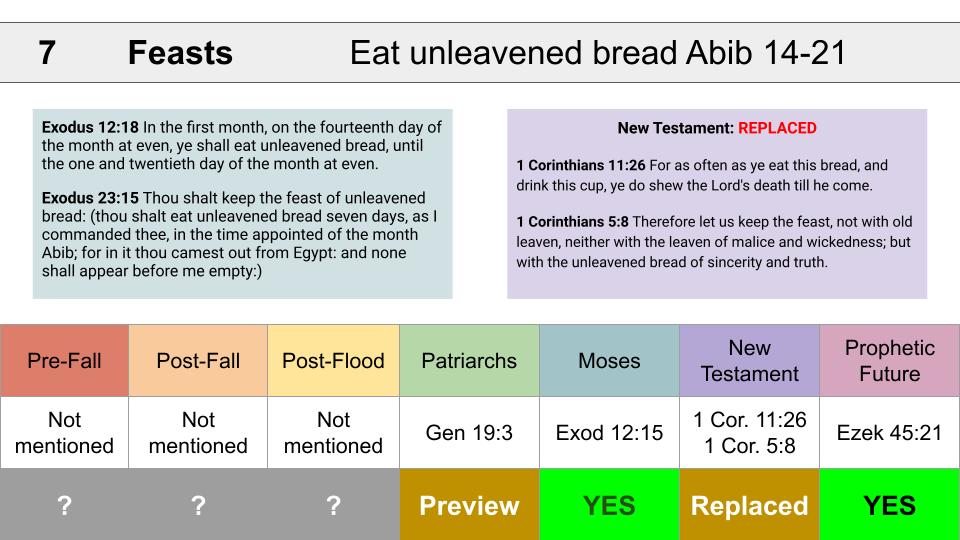
As we continue to look at the Passover Feast, we will contrast the negative command 6 with the positive command 7. Not only must the leavened bread be purged, but the unleavened bread must be consumed!
Let’s go back to Genesis 19:3 to look at the first reference to unleavened bread – an interestingly similar account of deliverance!
[1] And the LORD appeared unto him in the plains of Mamre: and he sat in the tent door in the heat of the day; [2] And he lift up his eyes and looked, and, lo, three men stood by him: and when he saw them, he ran to meet them from the tent door, and bowed himself toward the ground,
Genesis 18:1-2
God had met with Abraham (a foreshadowing of Moses?) to discuss coming judgment on Sodom (Egypt?).
And there came two angels to Sodom at even; and Lot sat in the gate of Sodom: and Lot seeing them rose up to meet them; and he bowed himself with his face toward the ground;
Genesis 19:1
The two angels came to Sodom (“the LORD went his way” -Gen. 19:33) and Lot prepares them a meal:
And he pressed upon them greatly; and they turned in unto him, and entered into his house; and he made them a feast, and did bake unleavened bread, and they did eat.
Genesis 19:3
Why would Lot make unleavened bread? Probably for the same reason the Israelites did – they didn’t have time to prepare!
And they bakedunleavened cakes of the dough which they brought forth out of Egypt, for it was not leavened; because they were thrust out of Egypt, and could not tarry, neither had they prepared for themselves any victual.
Exodus 12:39
Lot recognized these visitors and hurriedly made a feast to entertain these Very Important Persons before the judgment fell on Sodom.
[12] And the men said unto Lot, Hast thou here any besides? son in law, and thy sons, and thy daughters, and whatsoever thou hast in the city, bring them out of this place: [13] For we will destroy this place, because the cry of them is waxen great before the face of the LORD; and the LORD hath sent us to destroy it.
Genesis 19:12-13
Just as God brought judgment on Egypt, He brought judgment on Sodom.
[29] And it came to pass, that at midnight the LORD smote all the firstborn in the land of Egypt, from the firstborn of Pharoah that sat on his throne unto the firstborn of the captive that was in the dungeon; and all the firstborn of cattle.
Exodus 12:29
And yet the unleavened bread was a symbol that God would hastily snatch away His people before His judgment. Now we’ve read that Lot was a sorry figure, horrible parent, his married daughters were destroyed in the brimstone, his unmarried daughters committed drunken incest with him, but was He one of God’s people?
[7] And delivered just Lot, vexed with the filthy conversation of the wicked: [8] (For that righteous man dwelling among them, in seeing and hearing, vexed his righteous soul from day to day with their unlawful deeds;)
2 Peter 2:7-8
By ‘just’ Lot, even though it seems that he was the only one delivered, it means ‘just’ as in the sense of ‘righteous’ Lot. And if you were confused, the next verse clears up the confusion! A righteous soul vexed indeed! So even this vexed man Lot, was snatched out of Sodom. Why do I say ‘snatched’?
And while he lingered, the men laid hold upon his hand, and upon the hand of his wife, and upon the hand of his two daughters; the LORD being merciful unto him: and they brought him forth, and set him without the city.
Genesis 19:16
Roughly 600 years later, the Israelites would rush out of Egypt
And the people took their dough before it was leavened, their kneadingtroughs being bound up in their clothes upon their shoulders.
Exodus 12:34
Some day soon, there will be another event that will be sudden
In a moment, in the twinkling of an eye, at the last trump: for the trumpet shall sound, and the dead shall be raised incorruptible, and we shall be changed.
1 Corinthians 15:52
And will result in being snatched up
Then we which are alive and remain shall be caught up together with them in the clouds, to meet the Lord in the air: and so shall we ever be with the Lord.
1 Thessalonians 4:17
In Latin this reads:
deinde nos qui vivimus qui relinquimur simul rapiemur cum illis in nubibus obviam Domino in aera et sic semper cum Domino erimus
1 Thessalonians 4:17 (Vulgate)
We shall be caught up = rapiemur, more commonly known as the Rapture.
We’re continuing our study on the Passover – and we’re at the hunt for the leaven.
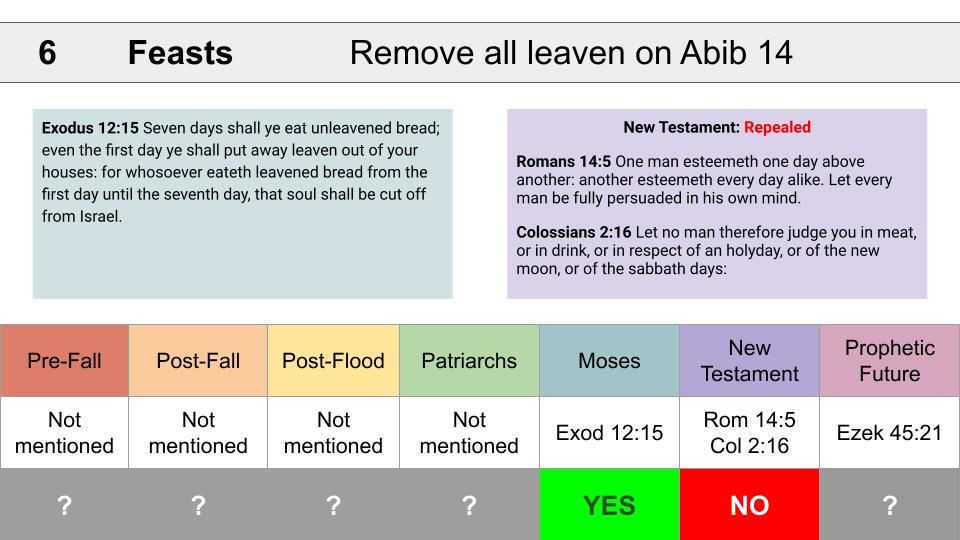
Seven days shall ye eat unleavened bread; even the first day ye shall put away leaven out of your houses: for whosoever eateth leavened bread from the first day until the seventh day, that soul shall be cut off from Israel.
Exodus 12:15
What happens if you happen to have some leaven – such as in a warehouse down the street?
A “shetar harsha’ah,” an authorization, is drafted, which gives the rabbi power of attorney. Those persons who wish to sell their leaven sign their names under this agency appointment and authorize the rabbi to act on their behalf. The authorization empowers the rabbi to sell the leaven they own, and the place where it is stored, at terms that the rabbi sees fit. The rabbi keeps the authorization and sells the leaven to a non-Jew by means of a “shetar mikheera,” which contains all of the terms of the sale. At the conclusion of Passover, one buys it back. [In reality the leaven is often not removed from the premises.] While this transaction is not intended to be a real sale, nevertheless, since all the formal requirements of a legal sale have been met, it satisfies the requirement of the law forbidding the possession of leaven during Passover.
So this is a new commandment – Abraham was not warned about leaven. And yet when we look at the New Testament, virtually every dated festival is abrogated:
One man esteemeth one day above another: another esteemeth every day alike. Let every man be fully persuaded in his own mind.
Romans 14:5
Let no man therefore judge you in meat, or in drink, or in respect of an holyday, or of the new moon, or of the sabbath days:
Colossians 2:16
Paul pretty much gets rid of this – and hundreds of other commands – effectively. However, he talks about the spiritual application of leaven. Jesus talked about the leaven of the Pharisees as well:
How is it that ye do not understand that I spake it not to you concerning bread, that ye should beware of the leaven of the Pharisees and of the Sadducees?
Matthew 16:11
But Paul talked about the leaven of the Corinthians:
[6] Your glorying is not good. Know ye not that a little leaven leaveneth the whole lump? [7] Purge out therefore the old leaven, that ye may be a new lump, as ye are unleavened. For even Christ our passover is sacrificed for us: [8] Therefore let us keep the feast, not with old leaven, neither with the leaven of malice and wickedness; but with the unleavened bread of sincerity and truth. [9] I wrote unto you in an epistle not to company with fornicators:
1 Corinthians 5
Here in 1 Corinthians 5 he discusses fornication in the church of the Corinthians and in the context of Passover urges them to practice judgment within the church
For what have I to do to judge them also that are without? do not ye judge them that are within?
1 Corinthians 5:12
Then he returns to internal judgment in 1 Corinthians 11
For if we would judge ourselves, we should not be judged.
1 Corinthians 11:31
in the context of the memorial of Passover, the Lord’s supper!
[22] What? have ye not houses to eat and to drink in? or despise ye the church of God, and shame them that have not? What shall I say to you? shall I praise you in this? I praise you not. [23] For I have received of the Lord that which also I delivered unto you, That the Lord Jesus the same night in which he was betrayed took bread: [24] And when he had given thanks, he brake it, and said, Take, eat: this is my body, which is broken for you: this do in remembrance of me. [25] After the same manner also he took the cup, when he had supped, saying, This cup is the new testament in my blood: this do ye, as oft as ye drink it, in remembrance of me. [26] For as often as ye eat this bread, and drink this cup, ye do shew the Lord’s death till he come. [27] Wherefore whosoever shall eat this bread, and drink this cup of the Lord, unworthily, shall be guilty of the body and blood of the Lord. [28] But let a man examine himself, and so let him eat of that bread, and drink of that cup. [29] For he that eateth and drinketh unworthily, eateth and drinketh damnation to himself, not discerning the Lord’s body.
1 Corinthians 11
Now looking ahead to the eschatological future –
In the first month, in the fourteenth day of the month, ye shall have the passover, a feast of seven days; unleavened bread shall be eaten.
Ezekiel 45:21
Interestingly the unleavened bread shall be ate, but there is no explicit command to purge the leaven. Is that because the Passover Lamb once shed for all – has not only taken away the bitter herbs but also the power of the leaven of sin?
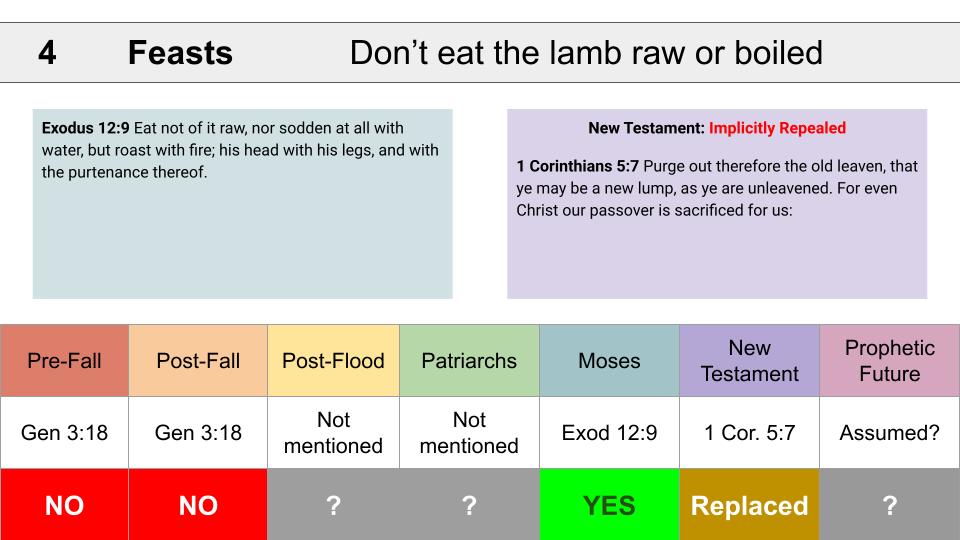
Much of this fourth commandment was covered in the discussion of the 3rd Mosaic Commandment. However we’ll look at the methodology of this commandment:
Not Raw
Not sodden with water (boiled)
As we’ll see in Numbers 20 – method is important. Because Moses struck the rock instead of speaking to it, he destroyed God’s symbolism and was banned from the Promised Land.
[8] Take the rod, and gather thou the assembly together, thou, and Aaron thy brother, and speak ye unto the rock before their eyes; and it shall give forth his water, and thou shalt bring forth to them water out of the rock: so thou shalt give the congregation and their beasts drink. [9] And Moses took the rod from before the LORD, as he commanded him. [10] And Moses and Aaron gathered the congregation together before the rock, and he said unto them, Hear now, ye rebels; must we fetch you water out of this rock? [11] And Moses lifted up his hand, and with his rod he smote the rock twice: and the water came out abundantly, and the congregation drank, and their beasts also. [12] And the LORD spake unto Moses and Aaron, Because ye believed me not, to sanctify me in the eyes of the children of Israel, therefore ye shall not bring this congregation into the land which I have given them.
So as we’ve seen earlier – the instructions are inapplicable in early human history, unknown between the Flood and Moses, and replaced by a new Passover Lamb in the New Testament:
Purge out therefore the old leaven, that ye may be a new lump, as ye are unleavened. For even Christ our passover is sacrificed for us:
1 Corinthians 5:7
Interestingly the requirement for it to be cooked not raw or boiled is not reiterated in the Ezekiel declaration so we might assume that it is assumed as it is not addressed.
Commentaries address this part of the symbolism:
Justin Martyr says that it was prepared for roasting by means of two wooden spits, one perpendicular and the other transverse, which extended it on a sort of cross, and made it aptly typify the Crucified One.
It was to be slain, and roasted with fire, denoting the painful sufferings of the Lord Jesus, even unto death, the death of the cross. The wrath of God is as fire, and Christ was made a curse for us.
 Dispensationalism and the Law