So we will slightly depart from Maimonides’ list of the 613 laws – because Maimonides tried to apply them to a post-Temple dispensation that forked from God’s dispensation of Grace.
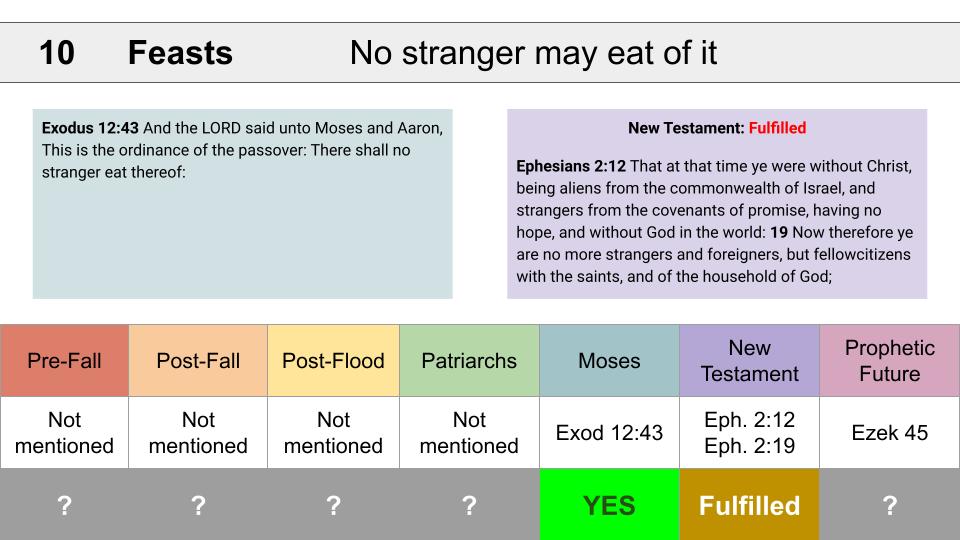
And the LORD said unto Moses and Aaron, This is the ordinance of the passover: There shall no stranger eat thereof:
Exodus 12:43
Maimonides, who was born on Passover Eve, interpreted strangers as apostates. Maimonides’ work often dealt with this issue of apostasy (from Judaism) because of forced conversions in traditional Jewish settlements.
However, taking a historical-grammatical approach to Scripture, we must look at who are the strangers of Exodus 12:43. We’re told by some sources there were short-term and long-term strangers, but there may be a different way to categorize strangers by looking at the text itself.
[44] But every man’s servant that is bought for money, when thou hast circumcised him, then shall he eat thereof.
[45] A foreigner and an hired servant shall not eat thereof.[48] And when a stranger shall sojourn with thee, and will keep the passover to the LORD, let all his males be circumcised, and then let him come near and keep it; and he shall be as one that is born in the land: for no uncircumcised person shall eat thereof.
Exodus 12
There appears to be non-Hebrews bound to Hebrews, non-Hebrews unbound, and non-Hebrews bound to non-Hebrews (either by blood – biological son, adopted son – or by otherwise). However you parse it, this is the first distinction in Mosaic code between the first two strands of the human family that Jimmy DeYoung was fond of discussing – the Gentiles and the Jews.
In the New Testament, Paul the learned Jewish sage explains what happened to the strangers. Note that Paul is discussing non-proselytes as opposed to proselytes (Gentiles that were circumcised could identify as Jews and participate in the Passover – we’ll discuss them in a future command) because circumcision was not the distinguishing mark of the third strand of the human family, Christians.
Where there is neither Greek nor Jew, circumcision nor uncircumcision, Barbarian, Scythian, bond nor free: but Christ is all, and in all.
Colossians 3:11
So what happened to these uncircumcised strangers? They had no hope!
12 That at that time ye were without Christ, being aliens from the commonwealth of Israel, and strangers from the covenants of promise, having no hope, and without God in the world:
19 Now therefore ye are no more strangers and foreigners, but fellowcitizens with the saints, and of the household of God;
Ephesians 2
God took hopeless strangers cut off from the Passover – and made them part of His household!
Those who could not participate in the symbol of the deliverance, are made partakers of the substance of deliverance!
 Dispensationalism and the Law