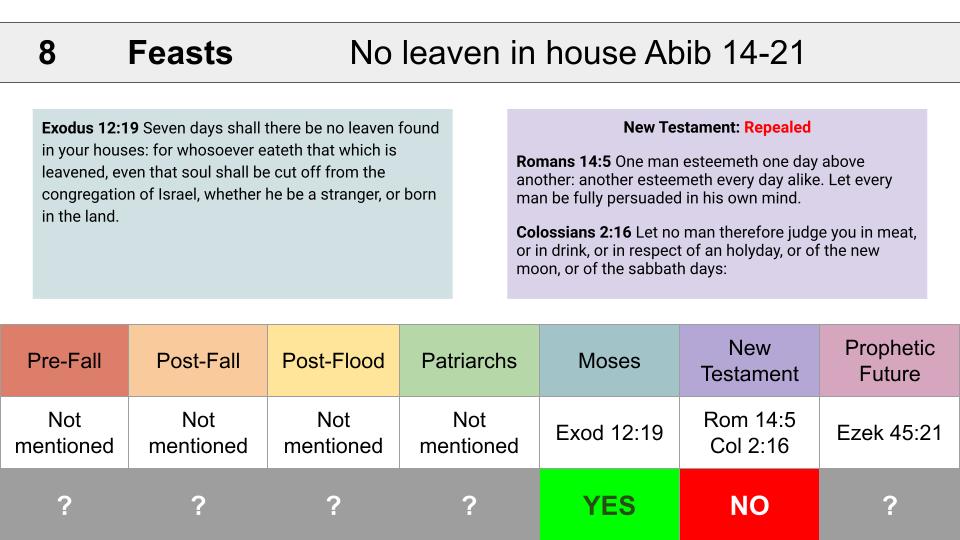
This law might look familiar – the 6th Mosaic command stated you had to remove the leaven, but this command continues to state you cannot bring it back for seven days.
Seven days shall there be no leaven found in your houses: for whosoever eateth that which is leavened, even that soul shall be cut off from the congregation of Israel, whether he be a stranger, or born in the land.
Exodus 12:19
Most people think of the Mosaic Code as austere – but they are thinking of the Mishnah. The Torah really isn’t as massive as we think – compare the 613 laws of Moses to over 16,000 laws in Wisconsin alone (not counting federal regulations). And much the Torah focuses on ceremonial law – festivals, sacrifices, and temple-specific regulation.
So what’s the big deal about leaven? Paul uses it as an illustration of fornication:
[1] It is reported commonly that there is fornication among you, and such fornication as is not so much as named among the Gentiles, that one should have his father’s wife.
1 Corinthians 5
[2] And ye are puffed up, and have not rather mourned, that he that hath done this deed might be taken away from among you.
[3] For I verily, as absent in body, but present in spirit, have judged already, as though I were present, concerning him that hath so done this deed,
[4] In the name of our Lord Jesus Christ, when ye are gathered together, and my spirit, with the power of our Lord Jesus Christ,
[5] To deliver such an one unto Satan for the destruction of the flesh, that the spirit may be saved in the day of the Lord Jesus.
[6] Your glorying is not good. Know ye not that a little leaven leaveneth the whole lump?
[7] Purge out therefore the old leaven, that ye may be a new lump, as ye are unleavened. For even Christ our passover is sacrificed for us:
[8] Therefore let us keep the feast, not with old leaven, neither with the leaven of malice and wickedness; but with the unleavened bread of sincerity and truth.
[9] I wrote unto you in an epistle not to company with fornicators:
[10] Yet not altogether with the fornicators of this world, or with the covetous, or extortioners, or with idolaters; for then must ye needs go out of the world.
[11] But now I have written unto you not to keep company, if any man that is called a brother be a fornicator, or covetous, or an idolater, or a railer, or a drunkard, or an extortioner; with such an one no not to eat.
[12] For what have I to do to judge them also that are without? do not ye judge them that are within?
[13] But them that are without God judgeth. Therefore put away from among yourselves that wicked person.
With the same devotion that the ancient Hebrews had to following the Passover to celebrate the deliverance God had brought to them accompanied by devotion to a pure “unleavened” home, so must we seek to have our lives pure and “unleavened” by fornication or any other sin.
 Dispensationalism and the Law