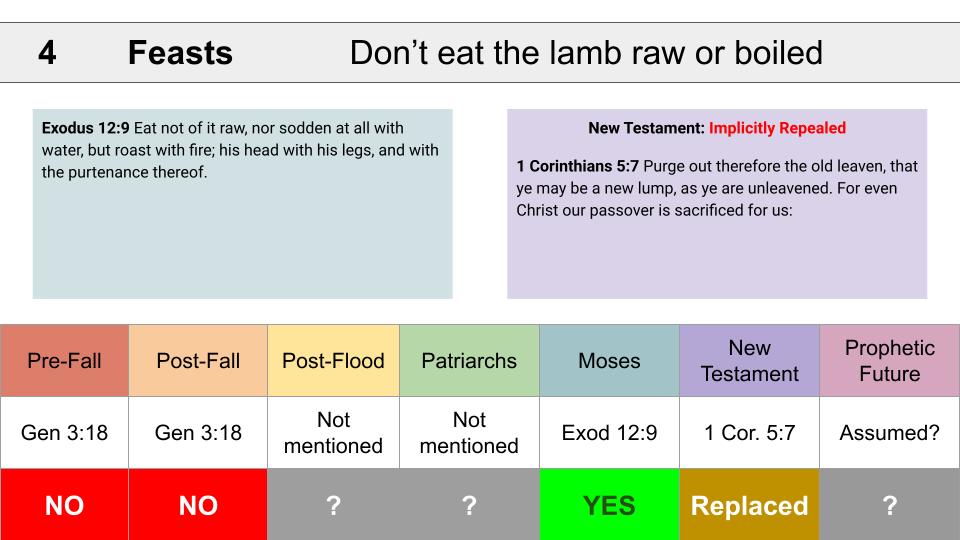
Much of this fourth commandment was covered in the discussion of the 3rd Mosaic Commandment. However we’ll look at the methodology of this commandment:
- Not Raw
- Not sodden with water (boiled)
As we’ll see in Numbers 20 – method is important. Because Moses struck the rock instead of speaking to it, he destroyed God’s symbolism and was banned from the Promised Land.
[8] Take the rod, and gather thou the assembly together, thou, and Aaron thy brother, and speak ye unto the rock before their eyes; and it shall give forth his water, and thou shalt bring forth to them water out of the rock: so thou shalt give the congregation and their beasts drink.
Numbers 20:8-12
[9] And Moses took the rod from before the LORD, as he commanded him.
[10] And Moses and Aaron gathered the congregation together before the rock, and he said unto them, Hear now, ye rebels; must we fetch you water out of this rock?
[11] And Moses lifted up his hand, and with his rod he smote the rock twice: and the water came out abundantly, and the congregation drank, and their beasts also.
[12] And the LORD spake unto Moses and Aaron, Because ye believed me not, to sanctify me in the eyes of the children of Israel, therefore ye shall not bring this congregation into the land which I have given them.
So as we’ve seen earlier – the instructions are inapplicable in early human history, unknown between the Flood and Moses, and replaced by a new Passover Lamb in the New Testament:
Purge out therefore the old leaven, that ye may be a new lump, as ye are unleavened. For even Christ our passover is sacrificed for us:
1 Corinthians 5:7
Interestingly the requirement for it to be cooked not raw or boiled is not reiterated in the Ezekiel declaration so we might assume that it is assumed as it is not addressed.
Commentaries address this part of the symbolism:
Justin Martyr says that it was prepared for roasting by means of two wooden spits, one perpendicular and the other transverse, which extended it on a sort of cross, and made it aptly typify the Crucified One.
Ellicott’s Commentary for English Readers
It was to be slain, and roasted with fire, denoting the painful sufferings of the Lord Jesus, even unto death, the death of the cross. The wrath of God is as fire, and Christ was made a curse for us.
Matthew Henry’s Concise Commentary
 Dispensationalism and the Law